How to play (TNChatZone rules)
- The aim. Checkmate the other king: attack it so that it cannot escape. White moves first, then the players take turns.
- Moving. Tap one of your pieces to see its moves as dots, then tap a dot — or drag the piece. The king steps one square, the queen slides any way, the rook straight, the bishop diagonally, the knight jumps in an L and the pawn walks forward and takes diagonally.
- Check. A king under attack is in check and glows red. You must get out of check at once; moves that leave your own king in check are not allowed.
- Castling. Move the king two squares towards a rook and the rook jumps over it — if neither has moved, the squares between are empty, and the king is not in check and does not cross an attacked square.
- En passant and promotion. A pawn that steps two squares past an enemy pawn can be taken as if it stepped one, but only straight away. A pawn reaching the last row becomes a queen, rook, bishop or knight — you choose.
- Draws. Stalemate (no legal move but not in check), the same position three times, 50 moves each without a capture or a pawn move, too few pieces to mate, or a draw offer the other player accepts.
- The clock. In timed games each player has their own clock that runs only on their turn. If your time runs out you lose — unless the other side cannot possibly mate, then it is a draw.
- Resign or offer a draw. On your turn you can resign, or tap ½ Draw: the offer goes with your next move and the other player can accept or decline.
Chess screenshots
Tips and strategy
- Take the centre: pawns and pieces on the four middle squares control more of the board.
- Develop first: bring out knights and bishops before moving the queen around, and castle early to keep your king safe.
- Count before you capture: a knight or bishop is worth about three pawns, a rook five and a queen nine. Do not swap a rook for a knight unless it wins something.
- Look for checks, captures and threats — yours and your opponent's — before every move.
- In the endgame the king becomes a strong piece: walk it towards the middle and help your pawns promote.
Know the levels
Easy looks only one move ahead and sometimes plays a random move — good for learning how the pieces move. Normal looks two moves ahead and rarely leaves pieces hanging. Hard searches four moves deep with every capture followed to the end, and punishes loose pieces.
A sample game start
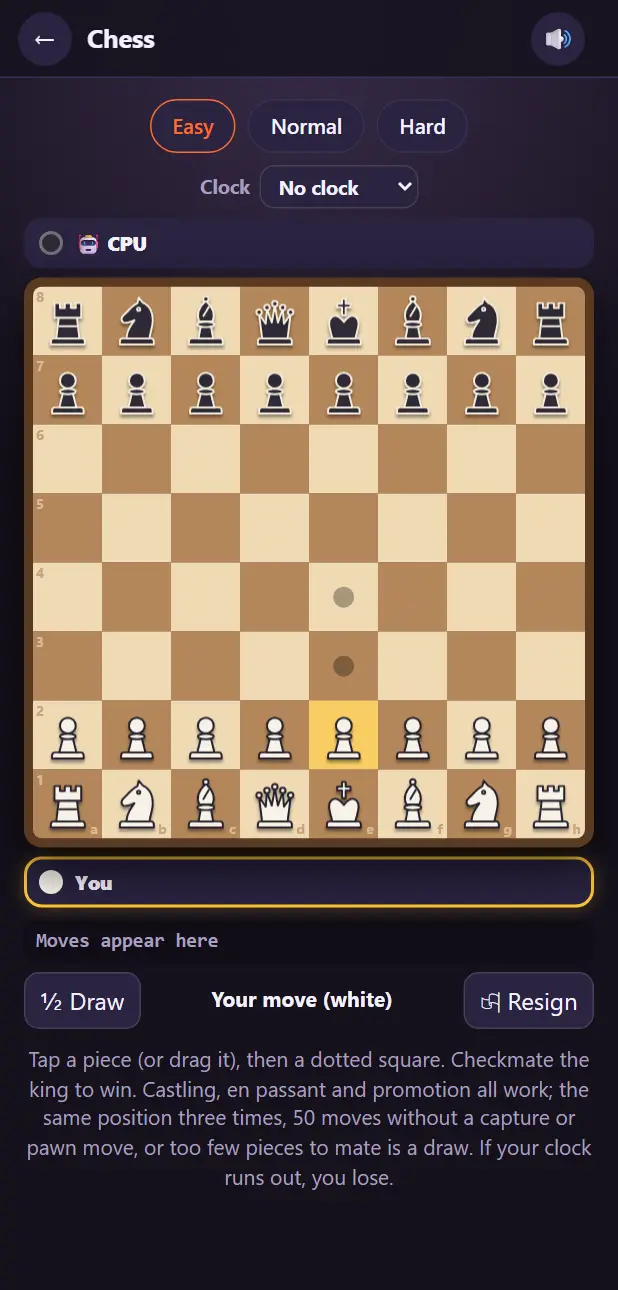
You have white. You play e4, opening lines for your queen and bishop; black answers e5. Your knight jumps to f3 and attacks the e5 pawn, so black guards it with the knight on c6. Your bishop goes to c4, aiming at the weak f7 square next to the black king, and black brings out the other knight to f6. Now you castle kingside: the king tucks away on g1 and the rook comes to f1, ready to join the game. Both sides have developed and the fight for the centre begins.
An Indian game played all over the world
The game that became chess started in India about 1,500 years ago as chaturanga, with pieces for the four parts of an army. It travelled through Persia to the rest of the world and changed its rules along the way; the queen's long moves were added only about 500 years ago. Today Tamil Nadu has produced many grandmasters, and children learn the game in schools across the state. The pieces in this game are our own simple drawings.
Play friends in the TNChatZone app
In the app chess is a live one-on-one match against a friend or anyone looking for a game, with a clock for each player. The server checks every move and runs the clocks, so both players always see the same board. If nobody joins, a 🤖 bot plays. Coins you win in the app are for fun and have no cash value.
FAQ: Chess
How do I castle?
Tap your king and then the square two steps towards the rook (or drag it there). The rook moves by itself.
How do I promote a pawn?
Move the pawn to the last row and pick a queen, rook, bishop or knight from the box that opens.
What happens when my clock runs out?
You lose the game, unless your opponent has too few pieces to ever checkmate — then it is a draw.
Why is my move not allowed?
Your king would be in check after it, or you are in check and that move does not end it. Only the dotted squares are legal.
Is there a computer opponent?
Yes. Play the 🤖 computer on Easy, Normal or Hard any time, with no clock or a 3, 5 or 10 minute clock.