Kolam Meaning and Traditions: Pulli, Sikku, Margazhi Kolams and Tips for Beginners
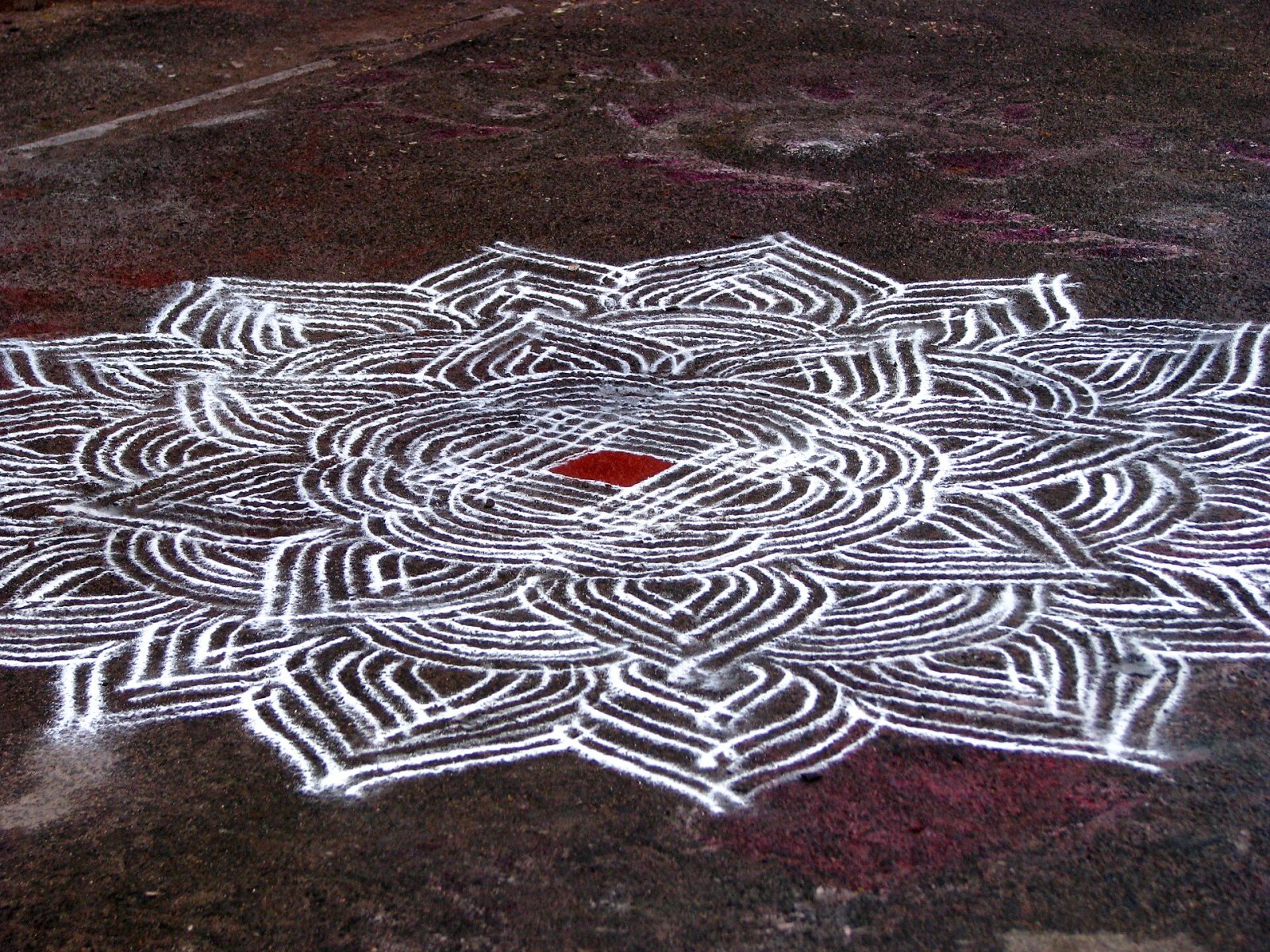
Walk down almost any street in Tamil Nadu early in the morning and you will see fresh white patterns at the doorsteps, drawn on ground that has just been swept and sprinkled with water. This guide looks at the kolam meaning as families commonly explain it, the main styles, the special kolams of Margazhi and Pongal, how kolam differs from rangoli, and how to draw your first one.
What is a kolam?
A kolam is a line drawing made on the ground, usually at the entrance of a house. It is traditionally drawn with rice flour, which is let fall in a thin stream from between the fingers. White stone powder, chalk and coloured powders are also used today, and on special days some families add red brick powder for contrast.
Kolams are meant to be temporary. People walk over them, rain washes them away, and a new one appears the next morning. That daily renewal is part of the practice, not a flaw in it.
The same idea is found across South India under other names: muggu in Telugu-speaking states, rangoli in Karnataka and pookalam (made with flowers) in Kerala. Tamil families in Sri Lanka, Singapore and Malaysia keep the habit too.
Kolam meaning: what families commonly say
Ask three grandmothers about the kolam meaning and you may get three answers, all of them sincere. These are the reasons most often given:
- Food for small creatures. Because the kolam is made of rice flour, it is often said to be a daily offering to ants, birds and insects, a small act of sharing at the start of the day.
- A welcome at the threshold. Many people say the kolam invites Lakshmi, the goddess of prosperity, into the home. Others link it to Bhudevi, the earth goddess.
- A threshold between inside and outside. The doorstep is where the home meets the street, and the kolam marks that meeting point with something orderly and clean before the day begins.
- Protection. Folk belief holds that a kolam with closed, completed lines keeps bad influences out of the house.
None of these explanations cancels the others. For most people the kolam is simply part of the morning, like lighting a lamp, and its meaning is felt more than discussed. The Wikipedia article on kolam collects several of these beliefs, and notes that many are passed down orally rather than written.
The main types of kolam
Names vary from district to district and family to family, so treat the labels below as a common way of grouping kolams, not fixed rules.
Pulli kolam (dot kolam)
Most traditional kolams start with a grid of dots called pulli. The number of dots in each row, and how the rows are staggered, decides the final shape. Two broad families grow from the dot grid: designs that loop around the dots, and designs that join the dots with straight lines.
Sikku kolam and kambi kolam (looped lines)
In a sikku (knot) kolam, curved lines wind around each dot without touching it, often as one continuous line that ends where it began. The Tamil words kambi (wire) and neli are also used for this looping line, so many families call these designs kambi kolam. Skilled artists draw large ones without lifting the hand, and finding the start and end point is a puzzle in itself.
Kodu kolam (joined lines)
In kodu (line) kolams, the strokes join the dots to form stars, flowers, lamps, birds and other shapes. These are usually easier for beginners because each line has a clear start and end.
Padi kolam and freehand kolams
Padi kolam is a name some families use for designs drawn on Fridays or auspicious days to welcome Lakshmi. Usage differs, so ask an elder in your own family what they mean by it. Freehand kolams, drawn without dots, are often coloured and are common on festival days.
Margazhi kolams
The Tamil month of Margazhi, which falls between mid-December and mid-January, is the high season for kolams. Women rise before dawn, and streets in many towns turn into an open-air gallery as households quietly compete over who draws the biggest or most intricate design.
A familiar Margazhi touch is a yellow pumpkin flower set on a small mound of cow dung in the centre of the kolam. The custom is less common in cities today, but you will still see it in villages and in older streets. Margazhi is also the month when Andal's Thiruppavai is sung in the mornings, which adds to the early-morning mood.
Festival kolams: Pongal and other days
Festival days bring bigger designs and more colour. For Pongal, popular motifs include the sun, sugarcane and a pot with milk foaming over its mouth, and some homes use soaked rice flour or coloured rice for these larger designs. Lamps are a favourite motif for the festivals of light. Read more about the festival of lamps in our Karthigai Deepam guide.
Weddings and other family celebrations are also marked with larger kolams at the entrance and, sometimes, all the way down the street.
Kolam vs rangoli: what is the difference?
The two words are often used as if they mean the same thing, and in daily conversation that is fine. Still, there are some useful differences:
- Kolam is the Tamil tradition. It is usually drawn every day, often in white rice flour only, and is built on dots and continuous lines.
- Rangoli is the broader pan-Indian word. It usually means colourful, filled-in designs made for festivals and special occasions.
- Many Tamil homes now mix the two: a traditional white outline filled with colour for Pongal or Deepavali, sometimes called a "rangoli kolam".
How to draw your first kolam: tips for beginners
- Pick a small grid. Start with 5 dots in a row and 5 rows (5 × 5), or a staggered grid of 5-3-1. Big designs come later.
- Prepare the ground. Sweep, then sprinkle a little water. Slightly damp ground holds the powder better.
- Hold the powder right. Take a pinch of rice flour or kolam powder between thumb and forefinger and let it fall as you move your hand, a little above the floor.
- Practise on paper first. Draw the dot grid in a notebook and trace the design with a pencil until you can do it without looking.
- Keep the lines even. Move your hand at a steady speed. Uneven speed gives thick and thin lines.
- Close every loop. Traditional sikku kolams end where they start. A closed line looks neater and is said to bring good luck.
- Copy, then change. Learn a few classic designs from an elder, then try your own variations.
If you want to train the visual memory that kolam drawing needs, try our free Kolam Memory game: it shows a path across a grid of dots, and you repeat it from memory, one extra dot each round.
Why the kolam is still worth learning
Kolam is a quiet daily habit that mixes art, patience and a little mathematics. Researchers have studied the symmetry of sikku kolams, and computer scientists have used kolam patterns to explore how pictures can be described with simple rules. For most families, though, the value is closer to home: a few minutes of calm at the doorstep before the day begins.
Understanding the kolam meaning also makes the festivals richer. When you see a Margazhi street full of designs or a Pongal pot drawn in coloured powder, you are looking at a tradition that has been passed from mothers to daughters for generations. For more about Tamil customs, see our Puthandu customs guide or test yourself in the festivals and food quiz.
Frequently asked questions
What is the kolam meaning in simple words?
A kolam is a pattern drawn at the entrance of a home, usually in rice flour. It is commonly said to welcome prosperity and to feed ants and birds, and it marks the doorstep as clean and cared for.
Why is kolam drawn with rice flour?
Rice flour is cheap, easy to draw with and, according to tradition, becomes food for ants and small creatures. White stone powder is also widely used today because it shows up more clearly.
Why are Margazhi kolams special?
Margazhi (mid-December to mid-January) is the peak season for kolams. Designs are larger, people draw them before dawn, and many add a pumpkin flower placed on a little cow dung in the centre.
Is kolam the same as rangoli?
They are closely related. Kolam usually means the daily Tamil dot-and-line design, often in white. Rangoli is the wider Indian term and usually means colourful festival designs.
How long does it take to learn kolam?
A simple 5 × 5 dot kolam can be learnt in a few days of practice. Large sikku kolams drawn in one line take much longer, so start small and practise on paper.