How to Play Pallanguzhi: Board, Setup, Sowing, Pasu and Simple Strategy
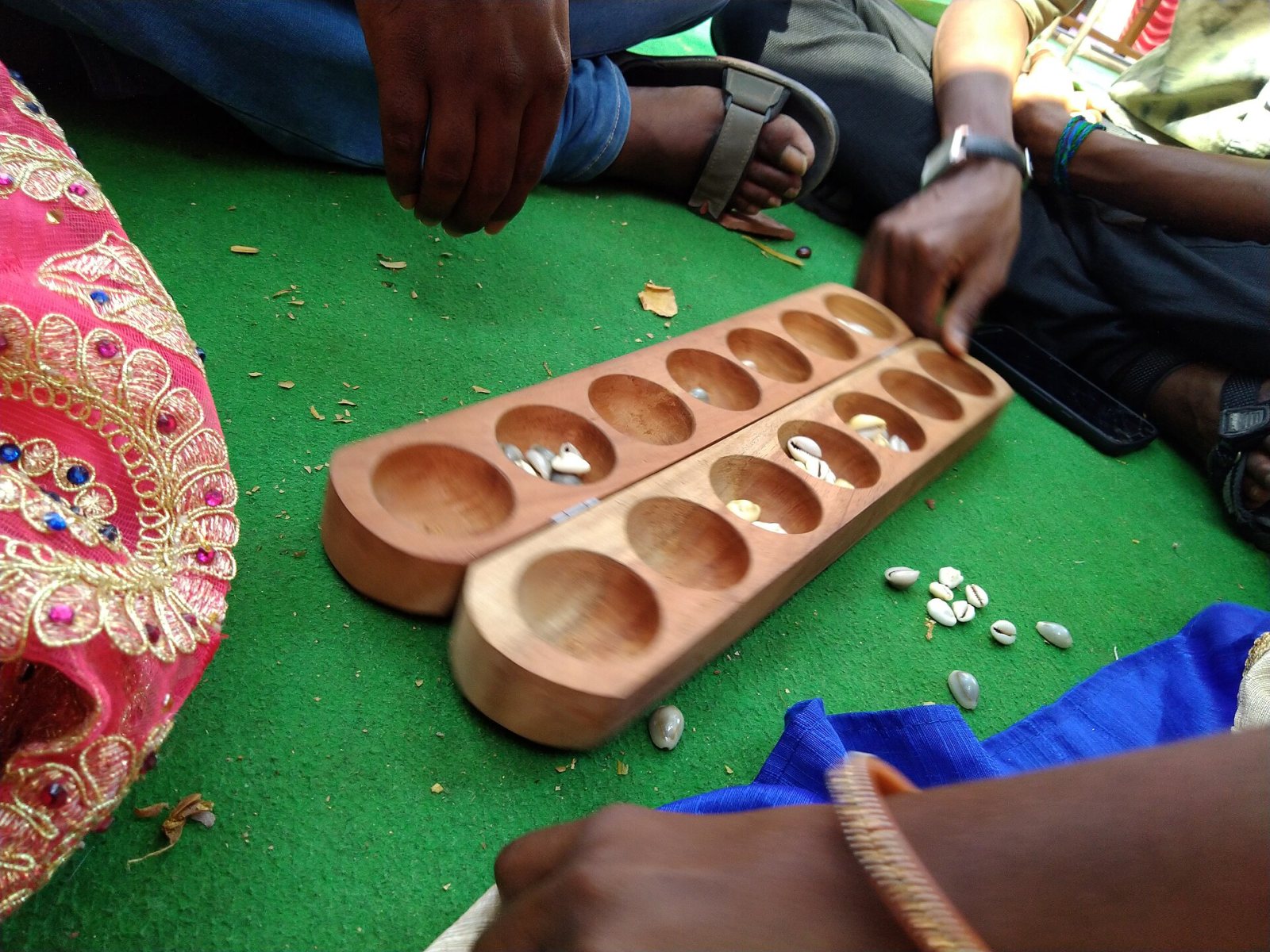
Pallanguzhi is the wooden board with fourteen cups that sits in many Tamil grandmothers' cupboards, usually with a cloth bag of cowrie shells or tamarind seeds beside it. If you have found one at home and nobody remembers the rules, this guide explains how to play Pallanguzhi step by step: the setup, sowing, captures, the famous "pasu" rule, how rounds work and a few tips to play better.
What is Pallanguzhi?
Pallanguzhi (பல்லாங்குழி, also spelt pallankuzhi or pallanguli) is a two-player game from the mancala family, the large group of "sowing" games played with seeds and pits across Africa and Asia. It is traditional in Tamil Nadu and Kerala, and is also known as pathinalam kuzhi, "fourteen pits".
Neighbouring languages have their own versions: Alaguli Mane in Kannada and Vamana Guntalu in Telugu. It spread to Sri Lanka and Malaysia, and is also played in Singapore and as far away as Trinidad and Guyana.
The board, the seeds and the setup
The board has 14 pits in two rows of seven. Each player owns the seven pits on their side. Boards are usually wooden, often hinged to fold shut, and some old ones are carved in the shape of a fish.
The counters are whatever the house has: cowrie shells (sozhi), tamarind seeds (puliyankottai), small pebbles or seeds of other trees. How many go in each pit depends on the family, so when you teach someone how to play Pallanguzhi, agree on this first:
- 5 per pit (70 in all): a common home setup, and the one used in the descriptions by folklorist Tho. Paramasivan.
- 6 per pit (84 in all): another common setup, used in a school maths project published in Teacher Plus.
- 12 per pit, with only 2 in the middle pit of each row (148 in all): a variant described on Wikipedia.
How to play Pallanguzhi: step by step
These are the rules most Tamil families share. Small details change from house to house, so settle any doubts before the first move.
- Sit facing each other with the board between you. The row nearest you is yours.
- The first player picks any non-empty pit in their own row and lifts out all its seeds.
- Starting with the next pit, drop one seed into each pit, moving anticlockwise (right along your row, then into your opponent's row and round again).
- When the last seed falls, look at the next pit. If it has seeds, lift them all and keep sowing from the pit after it.
- If the next pit is empty, you capture all the seeds in the pit just beyond the empty one, and keep them in your store. Your turn ends.
- If there are two empty pits in a row after your last seed, you capture nothing and your turn ends.
- Players take turns until the round ends.
A worked example
Say every pit holds 5 seeds and you lift the 5 from the third pit in your row. You drop one each into your 4th, 5th, 6th and 7th pits, and the last seed lands in your opponent's first pit. The next pit has 5 seeds, so you lift them and carry on sowing from the pit after it. Early in a round most pits are full, so the first turns run long; count aloud as you go.
The pasu rule
Pasu means cow, and it is the bonus everyone waits for. In the common version, any pit that reaches exactly four seeds during sowing is a pasu, and its seeds are taken out at once as a prize. Families differ on who gets it, the player who is sowing or the owner of that row, and the Wikipedia variant uses six seeds instead of four. Agree on this before you begin.
How a round ends and the next one starts
A round ends when the seeds run out. Depending on the house rules, that is when the board is empty or when the player whose turn it is has nothing left in their row; any seeds still on the board usually go to the owner of that side.
For the next round, each player refills their own pits from their store, with the same number per pit as before. A player who cannot fill all seven pits leaves the rest empty, and those pits are out of play for that round. Paramasivan records the Tamil name thakkam for these dead pits; Wikipedia calls them "rubbish holes".
A player who wins seeds back can reopen dead pits in later rounds. In the Wikipedia version, the player who started the last round goes second in the next. The game ends when one player cannot fill even a single pit, which makes a full game a slow, dramatic swing of fortunes.
Simple strategy tips
- Count before you lift. The number of seeds in a pit tells you exactly where your last seed will land. Count it out on the board with your eyes first.
- Look two pits ahead. The pit after your landing spot decides everything: full means you continue, empty means you capture the one after it.
- Watch for pits holding three. One more seed turns them into a pasu. Try to make that fourth seed land in your own row.
- Do not leave a rich pit right after an empty one. That is exactly what your opponent hopes to capture.
- Keep one heavy pit in reserve. A big pit sown late in a round travels all the way round the board and can change several pits at once.
Once you know how to play Pallanguzhi, you improve fastest by playing many short games and noticing what went wrong. Our brain games for family time post has more ideas for game nights.
Pallanguzhi in Tamil homes
Pallanguzhi has traditionally been a women's game, played at home by girls, young women and expectant mothers. It is also linked with festival nights: women traditionally played it to stay awake during the all-night vigils of Shivaratri and Vaikunta Ekadasi.
Its exact age is not documented. Game historians point out that most traditional Tamil games survive through oral history rather than written records, and the stories that place it in the Ramayana or the Chola courts are popular tradition, not proof. Folklorist Tho. Paramasivan has even read the game as a picture of how wealth gathers and inequality grows, as the losing player's pits fall empty round after round.
Elders often say Pallanguzhi sharpens counting, quick mental arithmetic and concentration, which is why children are encouraged to play with grandparents. Teachers have also used it in the classroom: the Teacher Plus school maths project used the game to get students predicting moves and writing down patterns. Treat these as everyday benefits of a thinking game rather than any medical claim.
Play Pallanguzhi online for free
No board at home? You can play Pallanguzhi online on TNChatZone in your browser against the computer. At the time of writing it uses 5 seeds per pit, the four-seed pasu rule (you can switch it off) and a single round, with the winner decided by the most seeds captured.
It is a quick way to learn how to play Pallanguzhi before you take out the real board with family. For more forgotten games such as Aadu Puli Attam, read our Tamil post on traditional Tamil games, or try Aadu Puli online.
Frequently asked questions
How many seeds do you put in each Pallanguzhi pit?
Most Tamil families use 5 seeds per pit (70 in all). Many use 6 per pit, and one documented variant uses 12 per pit with only 2 in each middle pit. Agree on the number before you start.
What is pasu in Pallanguzhi?
Pasu (cow) is a bonus: in the common version, a pit that reaches exactly four seeds during sowing is taken out at once as a prize. Families differ on whether the sower or the owner of that row gets it, and some use a different number.
Which direction do you sow in Pallanguzhi?
Anticlockwise in most descriptions: along your own row to the right, then into your opponent's row and round again.
Can I learn how to play Pallanguzhi online?
Yes. TNChatZone has a free browser version at /play/pallanguzhi where you play against the computer with the 5-seed setup and the optional pasu rule.