How to Play Aadu Puli Attam: The Tamil Game of Goats and Tigers Explained
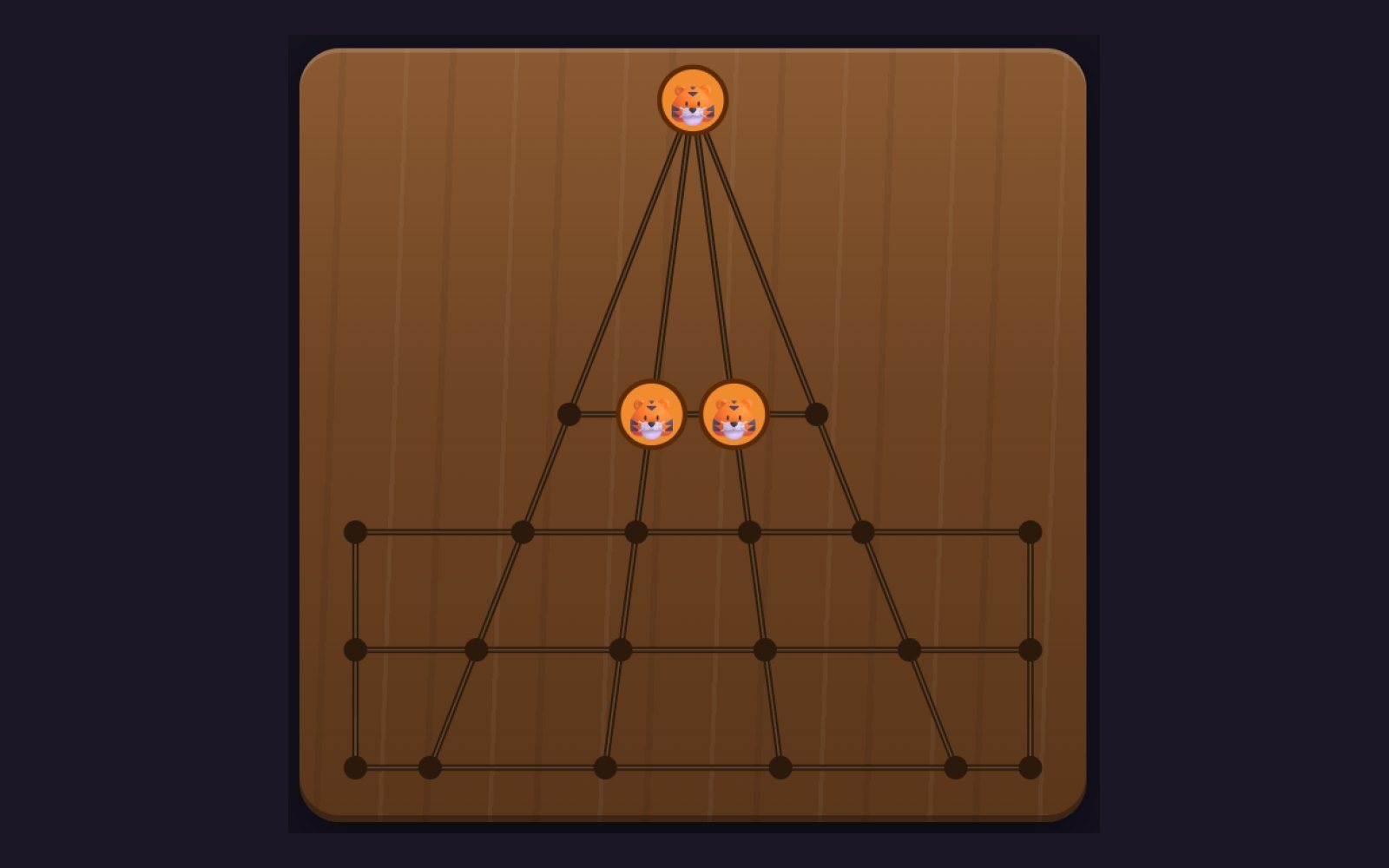
Aadu Puli Attam (ஆடு புலி ஆட்டம்), the "goat and tiger game", needs nothing more than a board scratched on the floor and a handful of stones and shells. One player has three tigers, the other has fifteen goats, and the two sides want completely different things. This guide explains how to play Aadu Puli Attam: the board, setup, moves, captures, how each side wins, the common house variations and some strategy for both sides.
What is Aadu Puli Attam?
Aadu Puli Attam is a two-player strategy game from South India, played in Tamil Nadu, Karnataka and the Telugu-speaking states. There are no dice, so the better player usually wins. It belongs to a family that game historians call "hunt games": one side has a few strong pieces that hunt, and the other has many weak pieces that try to trap them.
The game has many names. In Telugu it is called Puli Meka Aata or Pulijudam, and in Kannada Aadu Huli Aata or Huli Katti, which means "cage the tiger". A board for it is carved on the parapet inside the main gateway of the Chamundeshwari temple on Chamundi Hill in Mysuru. It is very close to bagh-chal from Nepal, which uses 4 tigers and up to 20 goats on a square 5 × 5 grid. The Wikipedia article on Lambs and Tigers lists these names and shows a few board variants.
The board and the pieces
The most common board looks like a triangle or a mountain. Several lines fan out from a single point at the top, and horizontal lines cross them. Pieces sit on the points where lines meet, not inside the boxes, and they move only along the lines.
Boards differ from village to village. The version used in our free online game has 23 points: the peak at the top, then rows of 4, 6, 6 and 6 points below it. Other boards have fewer rows or extra side points, but the idea is the same.
- 3 tigers (puli): often bigger stones, or shells of a different colour.
- 15 goats (aadu): small stones, tamarind seeds or shells.
- The board: drawn with chalk on the floor, scratched into stone, or on paper.
How to play Aadu Puli Attam: setup and moves
Families agree on the core rules, though small details change from home to home. Here are the rules used in our online Aadu Puli game, which follow the most common pattern.
Setup
The three tigers start at the top of the board: on the peak and the two middle points of the first row below it. All fifteen goats start off the board, in the goat player's hand.
Phase 1: placing the goats
- The goat player places one goat on any empty point.
- The tiger player moves one tiger one step along a line to a next empty point, or jumps to capture (see below).
- Players keep taking turns. Goats cannot move while any goats are still in hand; each goat turn is spent placing a new goat.
Phase 2: moving the goats
Once all fifteen goats are on the board (minus any already captured), the goat player moves one goat per turn, one step along a line to an empty neighbouring point. Goats can never jump and never capture.
Capturing: how the tigers jump
A tiger captures by jumping. If a goat is on the next point along a line and the point directly behind it, on the same straight line, is empty, the tiger can leap over the goat and land on the empty point. The goat is removed from the game.
- The jump must be in a straight line along a drawn line.
- The landing point must be empty.
- A tiger cannot jump over another tiger.
- In the common rules, only one goat can be taken per turn; some families allow chains of jumps, so agree before you start.
Capturing is not compulsory in most versions. A tiger may prefer to step quietly into a better position.
How each side wins
The goats win when none of the three tigers can make a legal move: every step is blocked and every jump is covered. This is the "caging" the Kannada name refers to.
The tigers win when they have captured enough goats that the rest cannot hope to trap them. The exact number is where homes differ most:
- A common target is 5 goats: by then the remaining goats are usually too few to cage three tigers.
- Our online version sets the target at 6 goats, and the tigers also win if the goats have no legal move.
- Some play to the end, with the tigers trying to take all 15.
- Our game also declares a draw after 60 moves in a row without a capture once all the goats are placed, so games cannot run forever.
Before the first move, decide which target you are using. It changes the strategy for both sides.
Strategy: how to play Aadu Puli Attam as the goats
Goats are weak alone and strong together. These tips come from the rules themselves: a goat can only be taken when the point behind it is empty.
- Never leave a gap behind a goat. A goat with another goat, a tiger or the board's edge behind it is safe from that direction.
- Fill the edges and the bottom rows first. Pieces at the edge have fewer open lines around them.
- Move in pairs and blocks. A solid wall of goats advancing together is very hard to jump.
- Watch for double threats. If one tiger move can attack two goats at once, you can only save one.
- Squeeze slowly. Take away the tigers' space a point at a time, and pin them near the peak where lines are crowded.
Strategy tips for the tigers
- Strike early. The tigers are strongest while goats are still being placed and gaps are everywhere.
- Stay spread out. Three tigers bunched together block each other's jumps and are easier to cage.
- Look for forks. Move to a point where you threaten two different jumps; the goat player can block only one.
- Keep an escape line. Avoid corners and the narrow peak once the board fills up.
- Be patient. If no capture is available, step into a central point and wait for the goats to make a mistake.
Learning the game with family
Learning how to play Aadu Puli Attam takes five minutes; getting good at the goat side takes much longer. A nice way to learn is to swap sides after every game and play a best-of-four. Children quickly see why the goats must stick together, which is a lesson older players like to draw from the game.
Like Pallanguzhi, this game was once found in almost every Tamil home. If you enjoy it, read our guide on how to play Pallanguzhi, try more ideas in fun brain games for family time, or play the other traditional games on our games page.
Frequently asked questions
How many tigers and goats are there in Aadu Puli Attam?
The common game uses 3 tigers and 15 goats. The tigers start on the board at the top; the goats start in hand and are placed one per turn. That is the first thing to know about how to play Aadu Puli Attam.
Can goats capture tigers?
No. Goats never jump or capture. They win only by surrounding the tigers so that none of them can move.
How many goats must the tigers capture to win?
It depends on the house rules. Five goats is a common target, our online version uses six, and some families play until all goats are taken. Agree before you start.
Is Aadu Puli Attam the same as bagh-chal?
They are close relatives in the same family of hunt games. Bagh-chal from Nepal is very similar, but it uses 4 tigers and up to 20 goats on a 5 × 5 grid, while the Tamil game uses 3 tigers and 15 goats on a triangular board.
Which side is easier for beginners?
The tigers are usually easier at first, because their aim is simple. The goat side needs more planning, which makes it the better side to practise once you know the rules.